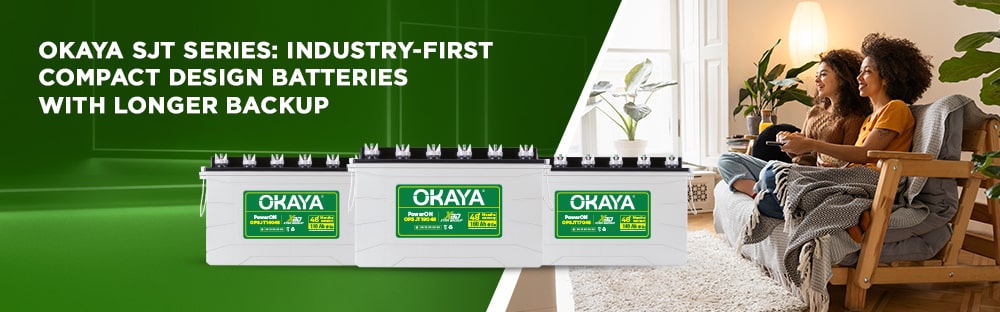
The existing blog title calls the SJT design industry-first, but no approved Okaya source supports that claim, so this guide sticks to what Okaya's SJT product page lists. The Super Jumbo Tubular (SJT) is a tubular battery, the kind of UPS battery that stores power for an inverter, and it is one option in Okaya's battery for inverter range for homes and offices.
Okaya's product page lists a compact design compared with an equivalent Tall Tubular battery. SJT batteries from 110Ah to 160Ah measure 540 x 210 x 317 mm, and the 160Ah 60-month PROPower model has a listed net weight of 50.3 kg. Okaya's data does not give a footprint comparison with Jumbo Tubular batteries, so check the dimensions of any other battery against your space.
Okaya states that the taller tubular plates in SJT give better performance, longer backup and easier water top-up than traditional Jumbo Tubular batteries. This is Okaya's own description and no figure is published for the plate effect alone.
Okaya states about 15% faster charging than conventional Jumbo Tubular batteries. This does not compare SJT with Tall Tubular batteries. How quickly the battery recovers after a long cut also depends on the inverter's charging.
Okaya lists a vent-plug design that prevents spills and a float design that allows water topping without removing the float plug. Okaya states that most models need only 1 to 2 water top-ups a year. Use the water specified in the product manual or by Okaya Care.
Okaya declares Certified Backup Hours for every SJT model, tested under the UMHD (Urban Metro Heavy Duty) load cycle in NABL-accredited laboratories and printed on the packaging. Okaya also states that XBD+ gives up to 15 to 20% longer backup than a conventional tubular battery of the same Ah capacity. Real backup varies with temperature, battery age, the inverter used and state of charge.
For the four SJT models and how to match a capacity to your load, see SJT inverter battery for home. For how SJT compares with Jumbo Tubular batteries, see SJT vs Jumbo Tubular batteries, and for Okaya's features-as-listed view, see why Okaya SJT is a strong inverter battery choice. Installation is typically arranged through your Okaya dealer, and the steps are covered in the guide to inverter installation. Use the dealer locator to find nearby Okaya dealers in your area.
Is the Okaya SJT the first compact inverter battery in the industry?
Okaya's data does not include a source for an industry-first claim. Okaya lists a compact design compared with an equivalent Tall Tubular battery.
What size is an SJT battery?
SJT batteries from 110Ah to 160Ah measure 540 x 210 x 317 mm. The 160Ah 60-month PROPower model has a listed net weight of 50.3 kg.
Is an SJT battery more compact than a Jumbo Tubular battery?
Okaya's product page compares the SJT with an equivalent Tall Tubular battery, not with Jumbo Tubular batteries. Check the dimensions of the Jumbo Tubular model you are considering.
What do the taller plates in an SJT battery do?
Okaya states that they give better performance, longer backup and easier water top-up than traditional Jumbo Tubular batteries.
How much faster does an SJT battery charge?
Okaya states about 15% faster than conventional Jumbo Tubular batteries. The inverter's own charging also affects recovery.
Can I top up water without removing the plug?
Okaya lists a float design that allows water topping without removing the float plug, and a vent plug that prevents spills. Use the water specified in the product manual or by Okaya Care.
Does a compact battery give less backup?
Backup depends on the model's Ah capacity and your load. Okaya declares Certified Backup Hours for each SJT model, so compare those at a load close to yours.
To compare the current UPS battery price and battery online options for each capacity, visit the Okaya shop.
 OKAYA POWER PVT. LTD.
ENERGIS D-7, 3rd & 4th Floor, Rohtak Rd,
Udyog Nagar, Mangolpuri,
New Delhi - 110041, INDIA
© 2026 All Rights Reserved to Okaya Power Private Limited